
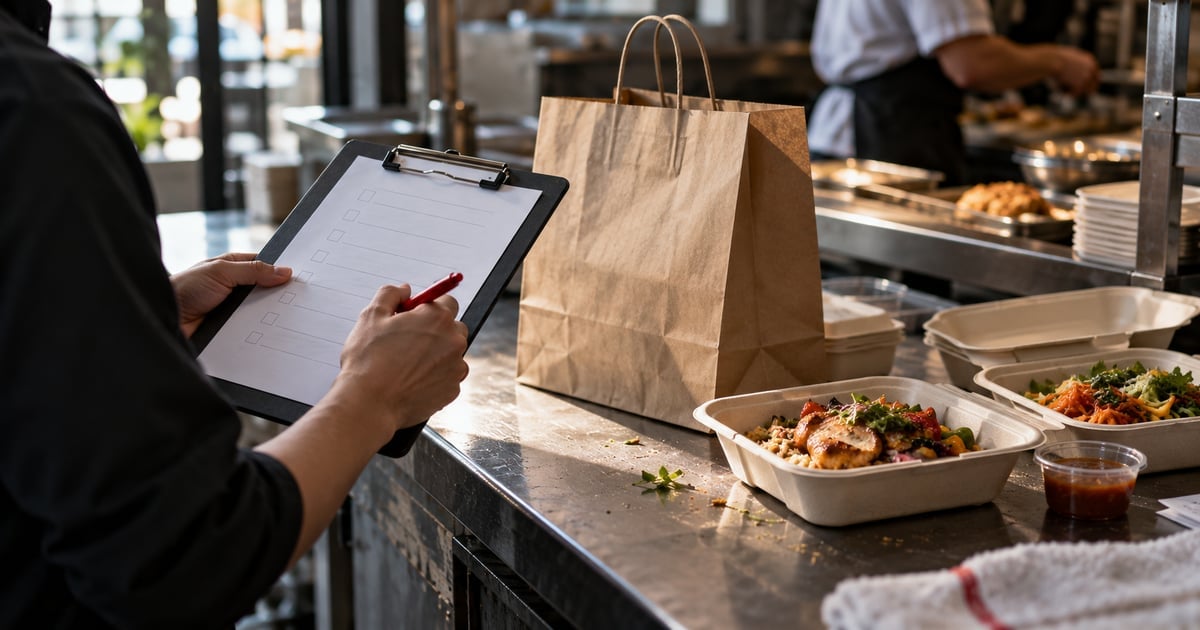

You feel your delivery could sell more, but you don't know where the problem is. So you boost a post, lower your prices, hire someone to run ads. The safest path is a checklist to improve delivery sales, one that shows you what is broken before you spend time and money in the wrong place.
All you need to do is go through yes-or-no questions, pillar by pillar, and write down the "no" answers. Here you get the ready-made roadmap and learn how to rank your "no" answers so you fix what weighs most first.
Key takeaways
- The audit has six pillars: product, Instagram, Google, online menu, paid traffic and CRM.
- Each item is a yes-or-no question. "Kind of" counts as "no."
- The priority order is product, menu, Google and Instagram, traffic, and CRM.
- Paid traffic only comes in when your product and menu are in good shape.
- Pick three to five items per week and repeat the audit afterward.
How do you use the checklist to improve delivery sales?
Answer yes or no honestly and list the "no" answers for each pillar. If your answer is "kind of," you are at "no." At the end, you rank the list by priority, as the last section shows.
Pillar 1: is your product on the same level as your competitors?
It is, if quality, delivery and price are comparable to those of the competitors in your area. Look at what you sell before making any marketing adjustment:
- Is your quality comparable to that of the competitors in your area?
- Is your delivery time in line with theirs, or better?
- Is your price in line with theirs, or slightly higher (and does the customer see a reason for it)?
- Do you invest, from time to time, in photos and videos of your product, whether professional or made by you?
If quality or delivery is a "no," no other pillar will make up for it for very long.
Pillar 2: does your Instagram lead customers to place an order?
Yes, when your profile and content show what you sell and lead people to your menu. First, the profile:
- Does your name follow the format "Business | Category in location"?
- Does your bio have three lines: your differentiator and the areas you serve, your format and hours, and a clear invitation to make a first purchase?
- Does the link in your bio lead to a link tree (menu, your main marketplace such as Uber Eats, DoorDash or Grubhub in the US, or Just Eat or Deliveroo in Europe, and WhatsApp) or straight to your menu?
- Is there a WhatsApp button and are there highlights with custom covers?
Since the Instagram bio accepts up to 150 characters, your three lines need to be short. Next, the content:
- Do you post well-made food photos 3 to 4 times a month in your feed, without generic offer templates?
- Do you post stories every day, with a link to your menu and behind-the-scenes content (except on days you're closed)?
- Do you avoid giveaways and work with influencers at least once every two months?
Pillar 3: is your Google profile complete?
It is complete when every field is filled in, correct and up to date. Someone searching for "pizza near me" lands on Google before they reach your Instagram. According to Google's help center, local results are based mainly on relevance, distance and prominence, profiles with complete and accurate information are more likely to show up, and you can't pay for a better local ranking. To fill in each field, see how to fill in your Google Business Profile. Check:
- Does the profile exist, with your brand name (and category), logo, primary category and additional categories?
- Does the description use keywords that customers actually search for?
- Is the WhatsApp number you registered valid, and is your online menu link set as the website?
- Are your regular hours and special-date hours correct, with the cities and neighborhoods you cover listed?
- Have all reviews been answered, and do you keep answering new ones?
- Are there weekly posts, new photos and videos, answered frequently asked questions, and a menu with photos and descriptions?
Pillar 4: does your online menu make ordering easy?
It does when it has photos, clear categories, real offers and a lean checkout. This is where the sale happens. To go deeper, see 7 adjustments to your online menu.
Structure
- Does the name of your menu follow the format "Business | location"?
- Do at least 80% of the items have a photo? (That is the benchmark in Idea's method.)
- Do you have the categories Best Sellers (only what truly sells), Combos, New Items, Deals of the Day (for slow days) and Featured?
- Does the second page offer upsell and cross-sell, only with the best-selling options, and cheaper than on the first page?
Offers
- Do combos and deals of the day have a real discount, with the was/now price visible?
- Is there an active first-purchase coupon (if possible, applied automatically in the cart) and a loyalty plan?
Checkout
- Do you ask only for the essentials, such as phone number or WhatsApp, with no email, date of birth or CPF (the Brazilian taxpayer ID number) on the first order?
Fewer clicks, more sales. Every extra field at checkout is one more reason for the customer to give up.
Pillar 5: is your paid traffic ready to receive ads?
Only if your product and menu are already in good shape, so get to this pillar after the previous ones. The questions:
- Is the pixel installed?
- Do purchase campaigns lead to the menu and cold-audience campaigns lead to the profile?
- Is there remarketing for the warm and hot audiences?
The Meta Pixel is a piece of code installed on your website that measures people's actions, and the setup has two steps: creating the pixel in Events Manager and configuring the events, such as a purchase.
Traffic is fuel, not a starting point. If your menu doesn't convert, advertising only increases the number of people who leave without ordering.
Pillar 6: is your CRM bringing customers back?
It is only bringing them back if you have an active CRM and campaigns running for people who have already bought. Ask yourself:
- Is there an active CRM, and do you know who orders the most and what they order the most?
- Are there campaigns to win back inactive customers, retain active ones and encourage reviews and NPS?
- Do you analyze retention order by order and the ratio of new to repeat customers each month?
If several items here are a "no," start by increasing repeat orders after the first order. The idea is simple: more customers coming in, more customers coming back, your delivery growing.
How do you prioritize the "no" answers from the audit?
Rank them like this: product, menu, Google and Instagram, paid traffic and, last, CRM.
- Product. Without quality, delivery and price, nothing else holds up.
- Menu. Photos, categories, offers and a lean checkout directly affect conversion.
- Google and Instagram. This is where customers find you and check you out before ordering.
- Paid traffic. It comes in when the base above is standing.
- CRM. It can be built in parallel, depending on your routine.
Within each pillar, start with the "no" that is quickest to fix and that brings the customer closest to ordering: a missing photo, wrong hours, an unnecessary field at checkout. To spot other points where you lose customers, see how to find out where your orders slip away.
What mistakes should you avoid when auditing your delivery?
The main ones are answering "yes" out of optimism, jumping to traffic, trying to fix everything at once, auditing only once and confusing a discount with an offer.
- Answering "yes" out of optimism. If the item exists but is outdated or half done, it is a "no."
- Jumping straight to traffic. It depends on all the other pillars.
- Auditing once and forgetting about it. Menus, hours and offers change; redo the checklist after a few weeks.
- Confusing a discount with an offer. A combo and a deal of the day need a real discount and a clear was/now price, not just a pretty banner.
Where to start
If you would rather do the audit with help, Idea can look at the six pillars with you. We don't promise revenue, because the result depends on many variables in your delivery business, but we show you where the "no" answers are and where to start.
Frequently asked questions
How many items should I fix per week after the audit?
Pick three to five items per week and finish them before starting others. Trying to fix everything at once usually leaves everything half done.
Can I run ads while I'm still fixing my menu?
Ideally, wait. Traffic is fuel, not a starting point: if your menu doesn't convert, the ad only increases the number of people who leave without ordering.
How many menu items need a photo?
At least 80% of the items, which is the benchmark in Idea's method.
Can I pay to show up higher on Google?
No. Google's help center states that you can't pay for a better local ranking. What helps is keeping your profile complete, with accurate information.
What counts as a "no" in the audit?
Anything that is not fully in good shape. If the item exists but is outdated or half done, or if your answer is "kind of," write it down as a "no."
Want to know where your delivery business can grow?
Tell us a little about your operation. Idea analyzes your situation and talks with you about a realistic priority.
Analyze my delivery business