
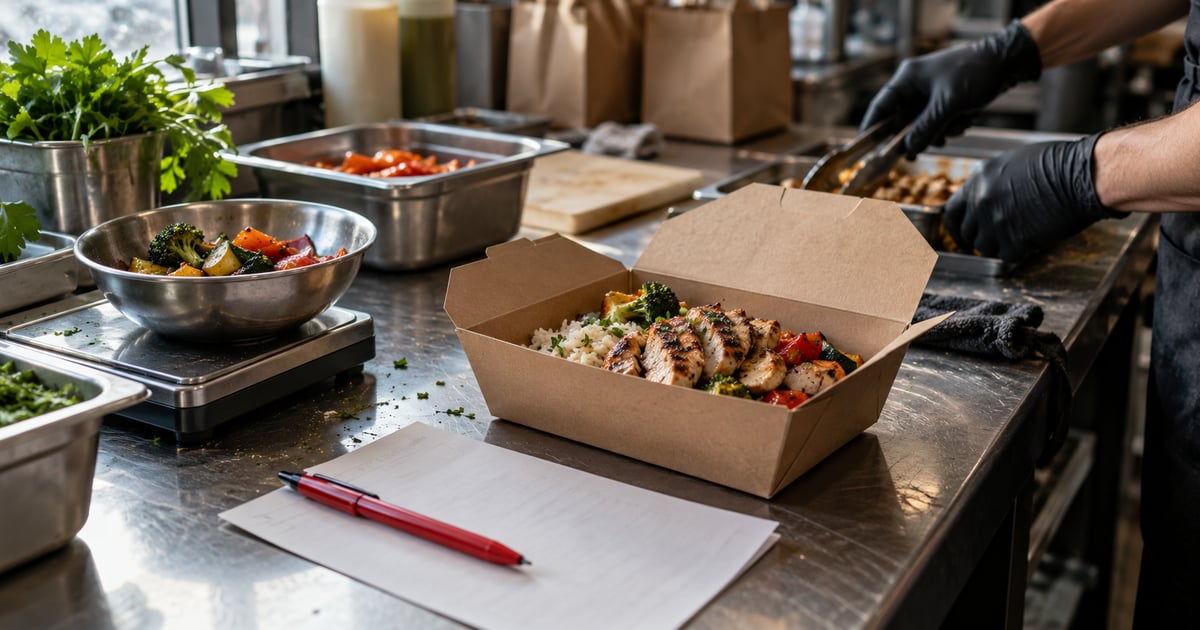

Many delivery owners change prices by gut feeling: they look at a competitor, sense that they are too expensive or too cheap, and adjust. The problem is that, without knowing how much each item costs, you can't tell whether the orders coming in leave you money or just move cash around.
In this article, you'll see what food cost is, why all pricing starts with it, what the ideal range is for a delivery business, and how to find the cost of your items before you touch a price, a combo or a promotion. The numbers below are illustrative examples, not the reality of your business.
Key takeaways
- Food cost is what it costs you to make what you sell, compared with the price you sell it for. All pricing has to take it into account.
- The ideal food cost range for a delivery business is between 30% and 35%.
- Before changing a price, a combo or an offer, find out the cost of each item.
- Without the food cost of the item, any price or combo suggestion is a guess.
- Combos can open up the margin a little to raise the average order value, but only up to a limit.
What is food cost and why does it weigh so much in delivery?
Food cost (cost of goods sold) is how much you spend to produce what you hand to the customer, relative to the price you sell it for. It is usually expressed as a percentage of the selling price.
In delivery, this math weighs more because the customer doesn't see the store and doesn't see the dish on the table. They see the price, the photo and the description on your online menu. If the price is out of line with the cost, you only find out when there is no money left at the end of the month, and by then the order has already been sold.
That's why Idea's position is simple: all pricing has to take food cost into account. Price, combo and promotion are decisions that come after it.
How do you calculate the food cost of an item, step by step?
Divide the item's cost by its selling price and multiply by 100. The result is the item's food cost, as a percentage.
Here is an illustrative example:
- List everything that goes into the item. Each ingredient and the amount the item uses. In delivery, it's worth including what goes out with the order too, such as packaging.
- Find the price you pay for each ingredient. Use the real amount you pay today, not the one you remember.
- Calculate the cost of the item. Add up what each ingredient costs in the amount used.
- Divide by the selling price. If the cost is R$ 17.50 (about US$ 3) and the price is R$ 50 (about US$ 9), the math is 17.50 ÷ 50 = 0.35. The food cost is 35%.
This item sits at the upper limit of the ideal range. If the same item cost R$ 20 (about US$ 4) to make and still sold for R$ 50 (about US$ 9), the food cost would go to 40%, outside the range.
What is the ideal food cost for a delivery business?
Between 30% and 35%. This is the reference Idea uses to evaluate a delivery menu.
That doesn't mean every item has to land exactly in this range. In combos, you can open up the margin a little to raise the store's average order value. But that is a conscious decision, with a limit, and not a discount given without knowing what is left over.
How do you find the price from the cost?
Do the math in reverse: divide the cost by the food cost you want to reach. Using the same example, with a cost of R$ 17.50 (about US$ 3):
- For a 35% food cost: 17.50 ÷ 0.35 = R$ 50.00 (about US$ 9).
- For a 30% food cost: 17.50 ÷ 0.30 = about R$ 58.33 (about US$ 11).
The difference between the two ends of the range is big. That's why knowing the exact cost matters more than rounding the price "to make it look nice."
What if I don't know the cost of my items?
This is the case for many people, and it is the starting point: before changing any price, find out the cost. In practice, that means working out which ingredients go into each item, how much of each the item uses, and how much you pay for those ingredients.
When an Idea client doesn't know their food cost, our approach is to help them find it. The reason is straightforward: without a known food cost for the item, you can't suggest a price or a combo with confidence.
If you're starting on your own, a practical order is to write down the cost of the items that sell the most and then work through the rest of the menu. A simple spreadsheet is enough at the beginning.
How does food cost apply to combos and daily specials?
It is the filter for any promotion. Two references Idea uses:
- Combos: the food cost calculated on the promotional price is at most 45%. The cost of the combo is the same whether you sell it at full price or at the promotional price. What changes is the weight of that cost in the price.
- Daily special: the fixed price is adjusted so that no item in the offer goes over the food cost limit, even the most expensive one to produce.
These two topics have more detail in their own articles. Here, what matters is understanding the order: first the cost, then the price, then the promotion.
Common mistakes when calculating delivery food cost
- Guessing the cost. Using a "more or less" value for an ingredient distorts the food cost of every item that uses it.
- Forgetting the packaging. In delivery, it goes out with the order and is part of what you spend to deliver.
- Changing prices without knowing the cost. Raising or lowering a price without the math is a bet.
- Giving discounts without looking at food cost. The promotion fills up with orders, but it can also fill up with losses.
- Thinking paid ads fix margin. Paid traffic is fuel: if the price doesn't add up, advertising only speeds up a problem.
Frequently asked questions
What is food cost in delivery?
It is the cost of goods sold relative to the selling price, as a percentage. It shows how much of each order's value goes out just to produce the item, before the business's other expenses.
What is the ideal food cost for a delivery business?
The ideal range is between 30% and 35%. In combos, you can open up the margin a little to raise the average order value, respecting the limit of 45% on the promotional price.
Can I change prices before I know my food cost?
It's not recommended. All pricing has to take food cost into account, and without a known cost for the item, any adjustment to a price, combo or promotion becomes a guess.
Where do I start if I don't have a recipe card?
Start by listing the ingredients of each item, the amounts used and the price you pay for them. A simple spreadsheet works. When an Idea client doesn't know their food cost, we guide them to find it.
Is the food cost of a combo different from the food cost of a single item?
The cost of the combo is the same, at full price or at the promotional price. What changes is the food cost percentage, because it is calculated on the promotional price, which is lower. That's why the combo limit is at most 45%.
Where to start
- List the ingredients and amounts for each item on your menu.
- Write down the real price you pay today for each ingredient.
- Calculate the cost and divide it by the selling price to find the food cost of each item.
- Compare with the 30% to 35% range and only then decide what to adjust in price, combo or offer.
If you want to do this math with support from people who work with delivery every day, Idea helps organize your menu, your pricing and the road to the ad. Idea clients have already generated more than R$ 1 million (about US$ 180,000) in sales through paid traffic alone, but only after the product and the math are in order. More customers arriving. More customers coming back. Your delivery growing. Talk to us.
Read also: Daily special in delivery: how to create one without burning your margin · How to set up your delivery Instagram: name, bio and link that lead to the order.
Want to know where your delivery business can grow?
Tell us a little about your operation. Idea analyzes your situation and talks with you about a realistic priority.
Analyze my delivery business