
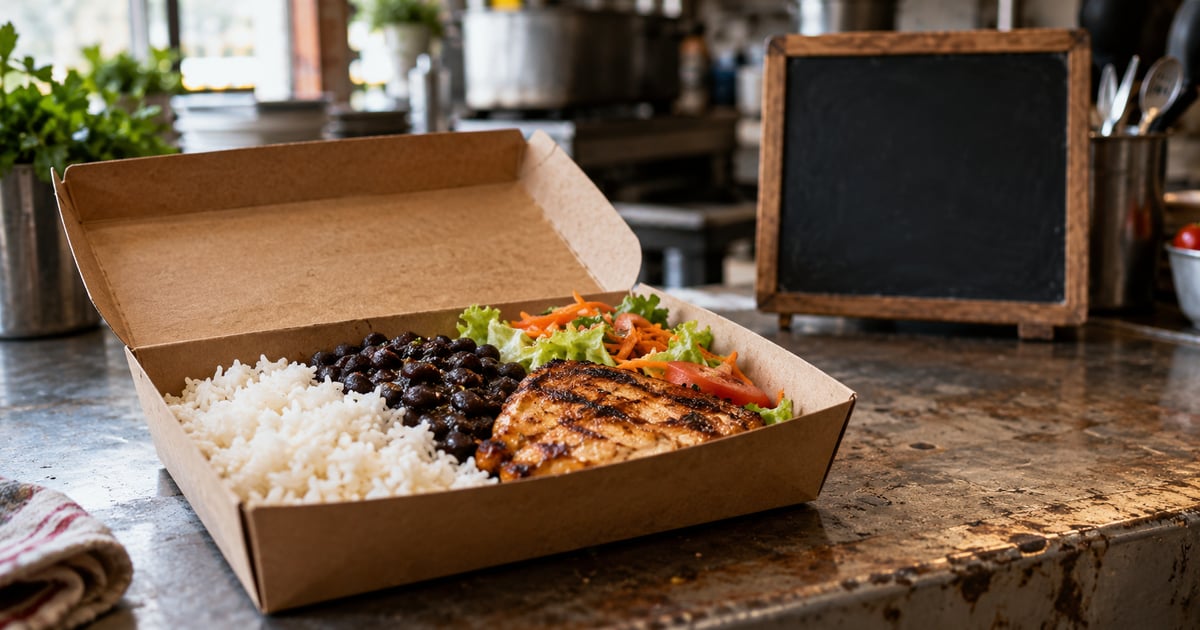

Monday through Thursday is usually the weak part of the week in delivery. Many owners react the fastest way possible: they throw a daily special out there, cut the price by eye and hope the orders show up. Orders do come in, but at the end of the month the numbers don't add up.
The problem is almost never the special itself. It's building it from a guess ("R$ 49.90 (≈ US$ 9) sounds like a good price") instead of starting from cost. In this article, you'll see which items belong in it, how to set the fixed price, how to show the Was/Now price and how to adjust the price to your worst item.
Key takeaways
- Every special starts from food cost: you set the cost ceiling before you set the price.
- Choose items with some turnover and a good margin.
- Run the special only Monday through Thursday, controlled by day of the week.
- Use a fixed price and calculate it from the worst item, never from the average.
- Show it in the Was/Now format, with a real discount.
Why does every daily special start from food cost?
Because food cost shows how much of the selling price goes away on ingredients alone. Food cost is the cost of goods sold: what the ingredients of an item cost, compared with the price you sell it for.
The food cost booklet from Abrasel, Brazil's bars and restaurants association defends the use of recipe cost sheets and says there is no single ideal food cost, only ranges by category (kitchen dishes: 25% to 40%).
As a reference from Idea's method, the ideal food cost for a delivery business sits between 30% and 35%. On combos and specials, you can loosen the margin up to a food cost of at most 45%, calculated on the promotional price. The full math is in how to calculate combo prices using food cost, and the logic is the same: the ceiling comes before the price.
One detail many people forget: the cost of the item is the same whether you sell it at full price or at the promotional price. The lower the promotional price, the higher the food cost percentage.
Which items go into the daily special?
Products with some turnover and a good margin. The special is aggressive, so the choice matters.
- Turnover: the item should be something customers already order, so the special has a chance to move.
- Good margin: if the item already starts with a tight food cost, the special pushes it into a loss.
An example from the pizzeria business: a client created a "Pizza of the Day" category with four 30 cm pizzas (special banana, pepperoni-style calabresa sausage, mozzarella and traditional margherita). All of them sell for R$ 49.90 (≈ US$ 9), in the Was/Now format, down from R$ 69.90 (≈ US$ 13) or R$ 74.90 (≈ US$ 14).
Why run the special only Monday through Thursday?
Because Friday, Saturday and Sunday already get more traffic, and an aggressive discount on those days gives up margin for no reason. Customers would already order at the regular price.
Control is by day of the week only, not by time of day: today is Tuesday, the special is live; on Friday it goes away. In your online menu, set the item as available during a specific period, and the category appears and disappears on its own.
To promote it, Google Business Profile lets you publish offer-type posts, with a title and start and end dates, which fits a promotion that runs on set days.
How do you set the fixed price and adjust it to the worst item?
Use one fixed price for all items and calculate it from the item that costs the most to make, never from the average. A single price makes the special easy to understand, and customers don't have to compare flavors. The trade-off is checking that the price holds up for the worst item.
Here's a calculation with made-up costs, just to illustrate. Consider a food cost ceiling of 45% on the promotional price and four pizzas with these ingredient costs:
- Mozzarella: R$ 18.00 (≈ US$ 3)
- Calabresa: R$ 20.00 (≈ US$ 4)
- Special banana: R$ 21.00 (≈ US$ 4)
- Margherita: R$ 24.00 (≈ US$ 4)
With a fixed price of R$ 49.90 (≈ US$ 9), the margherita would have a food cost of about 48%, above the ceiling. The other three would stay within it. Looking only at the average, the special would seem healthy and the margherita would keep selling above the limit.
The minimum price that respects the ceiling is the cost divided by 0.45. For the worst item: R$ 24.00 ÷ 0.45 comes to about R$ 53.33 (≈ US$ 10). Rounding up, the fixed price becomes R$ 53.90 (≈ US$ 10) on all four pizzas, and the margherita's food cost drops to about 44.5%.
Notice that the price didn't come from a guess or from a competitor's promotion. It came from the cost of the most expensive item and from the ceiling you set.
How do you build the Was/Now price without misleading the customer?
The "Was" price has to be the price the item really has on your menu, and the discount has to be real. The format works because it shows customers the size of the deal.
After adjusting the fixed price, check that the "Was" price is still well above the "Now" price. If the adjustment for the worst item pushes the promotional price up against the full price, the special loses its pull, and that item may not belong in it.
Presentation matters too. See when to use AI in food photos without misleading the customer: "A good product has to look good," but without promising what the kitchen doesn't deliver.
What if you don't know your food cost?
Then finding out your food cost is the first step, before any special. You need three pieces of information: the price you pay for each ingredient, which ingredients make up each item and how much of each one the item uses.
Without that, any special price is a guess. If you don't have the cost of an item, leave it out of the daily special until you know it. To look at your whole delivery operation before touching prices, use the delivery audit checklist by pillar.
What are the common mistakes in a daily special?
The most common mistakes are setting the price before food cost, calculating from the average and leaving the special running every day.
- Price before food cost. The promotional price comes from cost, not from wanting to look cheap.
- Calculating from the average. The item that costs the most to make sets the fixed price.
- Low-margin item in the special. An aggressive special needs a product with a good margin.
- Inflated "Was" price. The discount has to be real for the special to be credible.
Where to start this week?
Start by gathering the ingredient costs of the candidate items and set the food cost ceiling before the price. Then follow this order:
- Calculate the minimum price of the worst item (cost ÷ ceiling) and use it as the fixed price.
- Show it in the Was/Now format and set the category as available Monday through Thursday.
The special brings today's order. To get customers to come back, it's worth having a WhatsApp reactivation sequence at 15, 30 and 60 days. That is what Idea stands for: more customers coming in, more customers coming back, your delivery growing.
If you want help calculating your food cost, building specials that respect your margin and putting paid ads on top of an organized base, talk to Idea. The result of each delivery business depends on many variables in its own operation, so we don't promise revenue.
Frequently asked questions
Which food cost should you use for the daily special?
Set the ceiling before the price. As a reference from Idea's method, the ideal food cost is between 30% and 35%, and on specials and combos you can go up to at most 45% of the promotional price. Abrasel, Brazil's bars and restaurants association, points out that there is no single ideal food cost.
Which days should you run the daily special?
Monday through Thursday, controlled by day of the week only, not by time of day. Friday, Saturday and Sunday already get more traffic, and a discount then sacrifices margin for no reason.
Can you use the same price for items with different costs?
You can, and it's recommended: a fixed price keeps the special simple. Just calculate the price from the item that costs the most to make, so that no item goes over the food cost ceiling.
How do you calculate the minimum price of the special?
Divide the cost of the worst item by the food cost ceiling in decimal form. With a cost of R$ 24.00 (≈ US$ 4) and a ceiling of 45%, the math is R$ 24.00 ÷ 0.45, about R$ 53.33 (≈ US$ 10), rounded up to R$ 53.90 (≈ US$ 10) in the example.
Can you promote the daily special on Google?
Yes. Google Business Profile lets you publish offer-type posts, with a title and start and end dates, which helps promote a deal that runs on set days.
Want to know where your delivery business can grow?
Tell us a little about your operation. Idea analyzes your situation and talks with you about a realistic priority.
Analyze my delivery business