
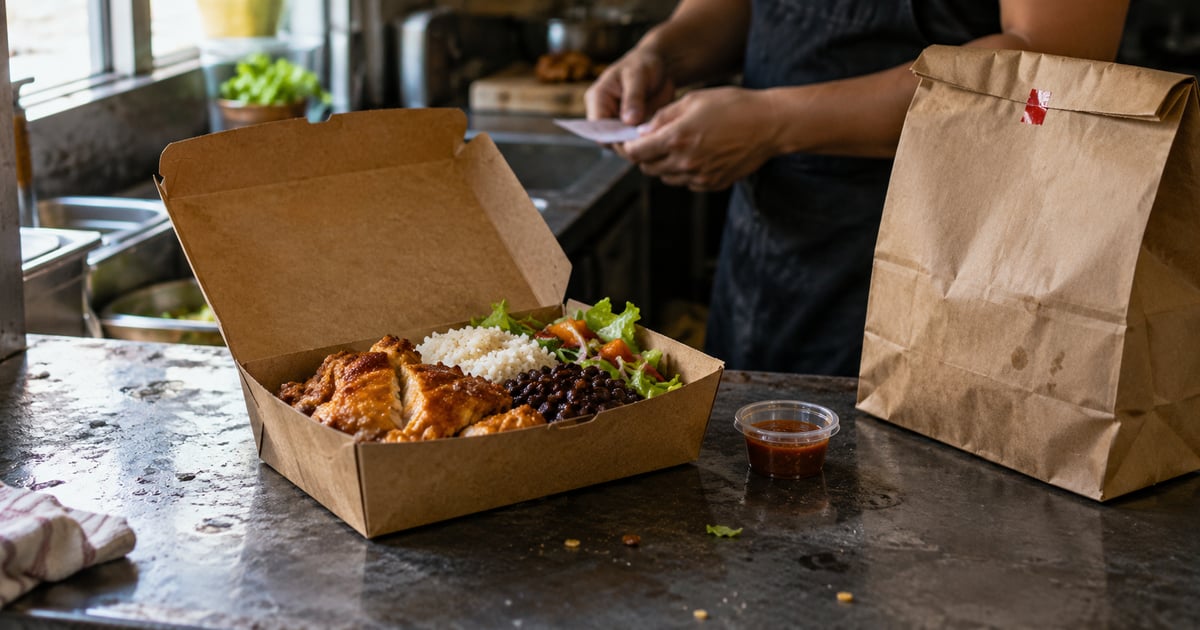

Many delivery owners look at flat sales and conclude they need more promotion. Sometimes they do. But in many cases the problem is in what leaves the kitchen: the food arrives cold, the customer orders once and disappears, or the orders come in and the numbers still don't add up at the end of the month.
Marketing doesn't fix a weak product. It only brings more people to what you already sell, for better or for worse. In this article, you'll see what a good delivery product is and a 3-sign test you can run on your own, with a decision rule: fix the product or invest in marketing.
Key takeaways
- A good product, in Idea's view, rests on three principles that must exist together: quality, delivery time and value for money, always compared with your competitors. Good customer service completes the equation.
- The 3 signs of the test: the product arrives well and is rated well, customers come back, and every item leaves a margin after fees.
- Paid ads won't save a delivery business. First you put the house in order; then you accelerate.
- If any of the signs fails, the investment goes first into fixing the product, not into ads.
What is a good delivery product and why does it come before marketing?
A good delivery product is one that delivers quality, delivery time and value for money at the same level as, or above, your competitors, with good customer service. The three principles must exist together. If one of them fails, the customer notices and doesn't order again.
- Quality equal to or better than similar options in the market.
- Delivery time comparable to or faster than your competitors.
- Value for money equal to or better than your competitors, so customers order often.
This is where the question comes in: "Who sells more, Fiat or Ferrari?" Neither is wrong. The point is to understand who you want to sell to and whether you're willing to pay to find out. A budget-priced pizzeria and a premium pizzeria can both be great businesses, as long as the product delivers what the price promises.
That's why the product comes first. In our view, the work of putting the house in order (product, social media, Google and your online menu) is halfway to a good result with paid traffic. Positioning doesn't depend on traffic; it's the other way around.
Sign 1: does the product arrive well and get good ratings?
The first sign is simple: what leaves your kitchen has to reach the customer's home the way you promised in the photo. If it arrives soggy, spilled or cold, no campaign makes up for it.
How do I know if my food arrives well at the customer's home?
Order from your own business to an ordinary address, at the typical distance of your deliveries, and open the packaging the way a customer would. Check:
- the temperature and texture when it's time to eat;
- whether it looks like the photo on your menu;
- whether any item leaks, gets crushed or loses its crunch;
- how long it took from order to doorstep.
Compare the time and quality with what a direct competitor delivers. Remember that delivery time is also one of the three principles of a good product.
What do reviews and complaints say about my product?
Read the reviews and complaint messages from your latest orders and sort them by theme: flavor, temperature, packaging, delays, missing items, customer service. The same problem repeated several times is a sign that the flaw is in the product or the operation, not bad luck.
Rule of thumb: if the same complaint keeps showing up, it goes to the top of the fix list before any investment in promotion. The same applies to the reviews on your delivery apps, such as Uber Eats, DoorDash or Grubhub in the US, or Just Eat or Deliveroo in Europe.
Sign 2: do customers order again?
The second sign is repeat orders. The value-for-money principle exists precisely so customers order often. A customer who orders once and doesn't come back is telling you that something about the product, the price or the service didn't convince them.
How do I measure repeat orders in delivery?
You don't need a sophisticated system to start. A spreadsheet with the name, phone number and date of each order already shows who bought more than once. Then look at your customer base and answer:
- Of the customers who ordered last month, how many ordered again?
- On average, how long do they take to come back?
- Are today's new customers coming back, or only the old ones?
If almost nobody comes back, advertising will only fill a leaky bucket: you pay to bring in new people, and they don't return. Here, the product, the perceived price and the service deserve a review before any budget is spent.
Sign 3: does every dish make a profit after commission, packaging and delivery?
The third sign is the one many people leave for later: margin. Selling a lot of an item that doesn't make a profit is just working for free with more orders.
How do I know if every menu item leaves a margin?
Build the math for each dish: the cost of ingredients (your food cost), packaging and the fees charged on the sale, such as the platform commission if you use one. This also applies to the delivery apps you use, like Uber Eats, DoorDash, Grubhub, Just Eat or Deliveroo. Compare the total with the selling price. The recipe costing sheet is the tool for this, and Abrasel (Brazil's restaurant association) and Sebrae (Brazil's small-business support agency) offer free material, in Portuguese:
Which items sell little and what should I do with them?
List your items by quantity sold. The ones that sell little have three paths: improve the presentation (photo and description), adjust the price or the recipe so they fit your margin, or take them off the menu. A lean menu, with items that sell and make a profit, makes the customer's choice easier.
How do I run a product test at home, step by step?
Put the three signs together on one self-test page. Print it and fill it in.
- Order from your own business and note the time, temperature and condition of the packaging.
- Order from a direct competitor and compare quality, time and price.
- Read the latest reviews and mark the themes that repeat the most.
- Count how many customers repeated their order in the last month.
- Calculate the margin of your best-selling items after ingredients, packaging and fees.
- Review your customer service: response time and how problems are solved.
When is the product ready to receive marketing investment?
The product is ready when the three signs are solid: it arrives well and is rated well, customers come back and the main items leave a margin. Only then does paid traffic act as fuel: it brings more people to a product that lives up to its promise.
When someone finds you through Instagram or Google, they need to feel desire for the product, find it easy to reach you and have an incentive for the first purchase, such as a first-order discount or fast delivery to their postal code. After that, all that's left is to deliver on what a good product promises.
What should I fix first if the product isn't good?
Fix first what the test showed to be most serious, in this order of thinking:
- It arrives badly: review packaging, dispatch time and what can be swapped out on the menu.
- Customers don't come back: look at reviews, perceived price and customer service.
- It doesn't leave a margin: redo the recipe costing sheet and adjust the price, recipe or portion.
Common mistakes
- Advertising to try to solve falling sales without looking at the operation.
- Believing a low price makes up for a weak product.
- Measuring only the number of orders and ignoring margin.
- Ignoring repeated complaints because "it was an isolated case".
- Wanting to be a Ferrari on price and a Fiat on delivery.
Practical wrap-up
- Run the 3-sign self-test this week.
- Fix the weakest sign before thinking about ads.
- Register your customers in a spreadsheet to measure repeat orders.
- Calculate the margin of your five best-selling items.
- With all three signs solid, then put budget into paid traffic.
If you want help putting the house in order and then accelerating, Idea works with a method that starts with the product and moves through social media, Google, online menu, paid traffic and CRM. We have already generated more than R$ 1 million (about US$ 180,000) in sales from paid traffic alone for our clients. We don't promise revenue or guarantee results: we deliver method, work and data. Talk to Idea and tell us how your delivery business is doing.
Frequently asked questions
How do I know if my delivery has a good product?
Compare your product with your competitors on quality, delivery time and value for money, and check your customer service. Then run the 3-sign test: the food arrives well and is rated well, customers come back and every item leaves a margin.
Does marketing fix a weak product?
No. Paid ads won't save a delivery business. They bring more people to what you sell, so if the product doesn't live up to its promise, the ad only magnifies the problem.
Who sells more, Fiat or Ferrari?
The question is there to help you position yourself. What matters is understanding who you want to sell to and whether you're willing to pay to find out, delivering what the price promises.
What do I need to fix before advertising?
Product, social media, Google and online menu. This work of putting the house in order is halfway to a good result with paid traffic.
Do I need good photos and videos to sell?
Yes. Whoever finds your delivery business needs to feel desire for the product, and the image of what you sell helps with that. It's also important to be able to create new material consistently.
Want to know where your delivery business can grow?
Tell us a little about your operation. Idea analyzes your situation and talks with you about a realistic priority.
Analyze my delivery business